Showing posts with label Style. Show all posts

Sunday, May 10, 2009

#73: The Magic Formula for Replacing Initials

I use acronyms or initials all the time when I'm writing, but unless I'm really pressed for space, I spell them out in the final version. I don't want to lose my reader in a morass of initials. (I wrote about avoiding acronyms here.)

CBO, NYS, DV, OJJDP, SAMHSA, NYC, DOH, clients names, DOE, DOJ, HHS, UNICEF,

I just found a neat trick that will save time in editing -- find and replace acronyms.

Of course, there's a secret code: <[A-Z]{2,}>

You plug the code into "Find what:" on the Edit menu, rub your magic mood ring, and click on Find or Replace. Make sure you've checked "Use wildcards."
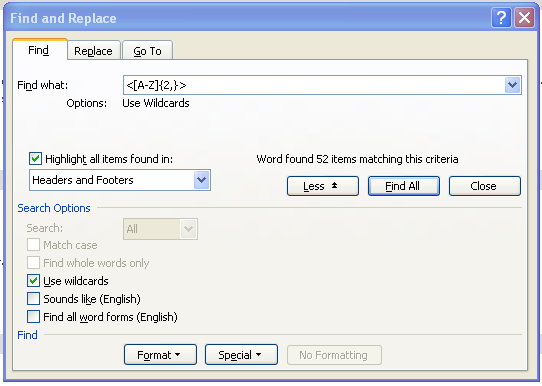

If you don't see the Search Options above, you'll see "More" where it says "Less" in this image. Click "More" then "Use wildcards."

Yes, it really works. Now, you can happily and quickly move through the document and decide which acronyms to spell out.

Thanks to LifeHacker reader Scott. And to bigvince1981 who recommended a free a document called "Advanced Find and Replace for Microsoft Word" at [www.editorium.com] As he said, "Who knew you could write 20 pages about find and replace. But it's an excellent (and free) read."

If you liked this post you may want to sign up for automatic updates. You can choose the RSS feed or an email subscription at the bottom of the sidebar.

Sunday, April 13, 2008

#51: Use Readability Statistics to Improve Your Grant Application


I find it hard to believe that I've offered fifty grant writing tips and I haven't included readability statistics yet. If you use WORD you'll find this an invaluable feature.

These are the statistics for a draft of a grant I was working on last week. I check on the statistics periodically, and always before I start serious editing.

Here's what these statistics tell me to look for when I'm editing:

Sentences per Paragraph 2.9 -- that's low. Low is good. It means lots of white space; separation of ideas. But, it's probably skewed by my frequent use of bullets.

Words per Sentence 17.6. TOO LONG! Well, now I know that as I edit I should look for sentences that include more than one thought.

Passive Sentences: 6% -- Good girl, Ruth! I've work hard to build the habit of writing in the active tense. I've written about that elsewhere.

Flesch Reading Ease Score: Rates text on a 100-point scale; the higher the score, the easier it is to understand the document. For most standard documents, the 'experts' aim for a score of approximately 60 to 70. Hmmm, mines only 36.1.

The formula for the Flesch Reading Ease score evaluates average sentence length (the number of words divided by the number of sentences) and average number of syllables per word (the number of syllables divided by the number of words). So, if I can reduce my sentence length by eliminating unnecessary wordiness and limiting sentences to one thought, I can probably get this score up.

Flesch - Kincaid Grade Level
-- Rates text on a U.S. school grade level. For example, a score of 8.0 means that an eighth grader can understand the document. For most documents, aim for a score of approximately 7.0 to 8.0. 12.6, my score, not good. Eighth grade can be tough a tough target for some grant applications, but I'll do what I can. This grant dealt with the court system and had significant court-related language.


How to Turn Readability Statistics on: Tools>>Options>> Spelling & Grammar>> then check 'Show readability statistics.' Once you've turned this option on, Readability Statistics display every time the spell-checker completes its review of your document.

(Note: In this same screen, you can also click settings to adjust the grammar checker to reflect your preferences regarding style and punctuation issues. OOPS! Does that count as resource #52?)


If you liked this post you may want to sign up for automatic updates. You can choose the RSS feed or an email subscription at the bottom of the sidebar.

Monday, March 17, 2008

# 50: Grant Writer! Accentuate the positive. Eliminate the Negative

You know that old song...
"Ac-cent-tchu-ate the positive. E-lim-inate the negative. Latch on to the affirmative.
Don't mess with Mr. In-between!"
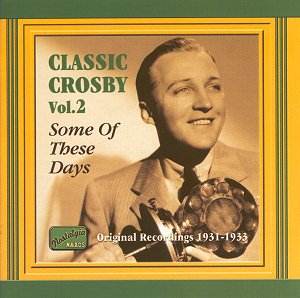
(Bing Crosby sang it. That's why his picture is here.)

Well, when we're writing about our organization's need for grant money, it's easy to focus on the negative. 'Kids are killing each other on the streets. The environment is going to hell. And, everyone in the neighborhood needs shoes.'

And, some days, the cup just seems half empty. Everything out of my mouth is negative.

But, as grant writers we know that our choice of language has a psychological impact on the reader. So, consider carefully the impact you want to have.

While a some negative language about the problem may be inevitable, leave the reader with positive feelings. I reread my text to find negative sentences and try to rewrite them as positives.
Without your funding the situation will continue to deteriorate and life will be miserable.
versus
With these additional resources the neighborhood can rise to the challenge and solve some of its problems.
Now, doesn't that feel better? Well, you know what I mean.

Wednesday, March 12, 2008

#45: Can a catchy name help get a grant application funded?

Do you think a catchy name for your program that is also descriptive of the project can make a memorable first impression?

Project names can be challenging. Sometimes we just stick with the title of the RFP -- bureaucratic and boring -- and sometimes we get quite hysterical brainstorming for a name when the application deadline presses.

And, I'm always interested in whether a client sticks with the catchy name we used in the application or ends up changing it during implementation.

Nancy Friedman presented six naming strategies in a two-part article on Visual Thesaurus. A couple of them won't work well for grant applications but most will trigger some ideas.
  1. People's names - who has inspired this program? Who's the founder?
  2. Connecting two words, like CareerWorks, Facebook, Wordpress
  3. Blended, or portmanteau, names like Technorati (a blend of technology and literati) - these are tricky.
  4. Affixed words - using a prefix or suffix with a descriptive word. For example, add Bene-, Bio- or Pre- at the beginning, or -ist, -ish, -cast, -ly, -ite at the end. BeneWorks, maybe, or BeneFunds;
  5. Invented words -- like all those accounting/consulting firms and the pharmeceuticals advertised on TV -- not a good choice for our projects.
  6. Phrases like 'Habitat for Humanity' and 'Teach the People.' One client's after school program is called 'McKee After 3'
Please note, Nancy didn't add acronyms to her list. Let's avoid ACE (Achievement it Career and Education) and ACT (Assisting Children Through Transition).

If you liked this post you may want to sign up for automatic updates. You can choose the RSS feed or an email subscription at the bottom of the sidebar.

Sunday, August 05, 2007

Grant Writing Easier Than You Think?


Executive Director Lain Shakespeare at the Wren's Nest in Atlanta may have it right. What do you think?
The Wren’s Nest » Ketchum: Wren’s Nest Wins!: "I don’t want to jinx myself, but it seems like grant writing is a lot easier than professional grant writers would have you think. Actual writing talent is way overrated–personality goes a long way, and nobody can tell your story better than you.

After you identify your grant and maybe perform a little research at the Foundation Center, all you’re gonna need is three things: passion, precision, and knowledge of your audience.

The last one is most important because each grantmaker has different rules. Learning these rules is like learning your manners all over again."

Friday, March 16, 2007

#33: Eliminate the Dreadful 'his/her' from Your Grant Narrative


Don't you just hate to write sentences like "The most improved student will present a portfolio of his/her work?"


But, I'm a feminist. Gender neutrality matters. So, try out these techniques.
  • Convert those sentences to the plural, if that will work
  • Avoid the pronoun altogether -- "The most improved student will present a portfolio of work."
  • Use the singular "their" -- "The most improved student will present a portfolio of their work."
I only recently read about the singular 'their' and intend to use it more often.
Yes, generally singular nouns take singular pronouns. But as you aptly note, 'his/her' is awkward and using only 'his' skews the meaning of a sentence. Using 'their' as a singular, inclusive pronoun has historical precedent and promotes the meaning better than those choices.

This choice has historical legitimacy, is acceptable for all informal writing and — if used consistently — for formal writing as well (though some will raise their eyebrows).

Sources: Professional Training Company: Communication Strategies for Scientists and Engineers and The American Heritage Dictionary of the English Language, 3rd edition. NY:Houghton Mifflin Company, 1992

Photo by
Henrik Ahlen

Tuesday, March 13, 2007

My New Grant Writing Help Web Site

I've just published a new website - Grant-Writing-Help.com. A work in-progress to be sure, but fun to do. Take a look and tell me what you think.

I'm in the pause between intense grants. Trying to take a deep breath. Clear the brain. Get some fresh air. Think about other things.

I finished an application to provide transition services for soon-to-graduate high school students with disabilities. I'm picking up speed on two new ones -- a mentoring grant and a community drop-in center/after-school program.

I find that during these brief pauses I surf through craft sites, fashion sites, Flickr groups -- lots of pictures and no words. Lots of color -- no black and white.

Do you use color in your grant applications? I haven't, but I'd like to. It could make the pages more readable if carefully applied. The problem rests with the unknown. Will the evaluator read it on-line and with color? or print it out in black and white, anyhow?

Photo by Chris Gierszewski

Friday, February 02, 2007

#28: How to Avoid Acronyms in Your Grant Applications


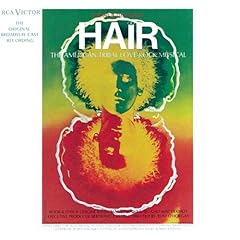
Remember that song from HAIR?
LBJ took the IRT down to 4th Street, USA. When he got there what did he see? The youth of America on LSD.
I recently came across this Acronyms.pdf on the Good Grammar, Good Style website. The author, Helen Moody, scolds us for using acronyms. She points out (in a most entertaining fashion) that acronyms are writer-centric. And we need to serve the reader, not ourselves.

I'm guilty! I admit it. And, I promise to do better. No more writing out the phrase once, with the abbreviation in parentheses. After all, I want them to remember my client's name.

Moody's pdf covers the whys and where-fors of acronyms and offers some good work-arounds to help avoid them. It's a quick and entertaining read.

Good Grammar, Good Style (tm): "The Good Grammar, Good Style™ Pages"

Wednesday, January 10, 2007

#26: Grant Writers, More White Space, Please!

Alison Snyder reminded scientists of some basic tenets of grant writing in a recent article in The Scientist. One of her points was that aesthetics count. In addition reminding them to follow directions about font size, margins, and spacing, she encouraged them to pay attention to how the page as a whole looks. Add space between paragraphs. Use headings and sub-headings.

This point prompted the following great comment about white space.
Applicants generally do not appreciate the importance of [white space]. "White space" in a proposal allows a reviewer to annotate the document while reading, instead of jotting comments on a note pad, which can be missplaced prior to writing a formal critique. In addition, white space "lightens" the document in a reviewer-friendly way. Applicants should consider that their proposal may be read by a reviewer late at night when a baby is crying or on an airplane travelling to a meeting. The more reviewer-friendly, the better.
Robert B. Trimble, PhD, Director, NIH Office of Research

I try to put myself in the readers shoes, and I'm very conscious of white space from an aesthetic perspective. I want my proposal to be a pleasure to read when the reviewer pulls it out of the stack. But I have to admit, I never thought about making it easy for the reviewer to make notes directly on the document. Thanks for the insight, Dr. Trimble.

Monday, December 04, 2006

#23: When Grant Writing, Use Those Easy Pieces Wisely

Today's Non-Profit Times e-newsletter had a brief article on grant writing. Their advice --

Grants ...Start the process with the easy sections You've done the research, found grants to apply for, assessed your organization's ability to complete a competitive proposal. Now it's time to actually start writing your grant proposal. What's the first thing you should do? Don't panic,according to Alexis Carter-Black, author of "Getting Grants: The Complete Manual of Proposal Development and Administration.

...She suggests breaking up the proposal into smaller sections and writing one section at a time, starting with the one you find easiest -- it doesn't even have to be in order until you send it in.

It's good advice to break the proposal into smaller sections. Then, find the strategy that works best for you.

Rather than do all the easy stuff first, I like to spread it throughout the writing process. I write an easy section whenever I need a break. I may need to let a more challenging section percolate a bit, or just have a hard time getting started one morning.

Whether you do the easy stuff first, spread it around, save it for last, do an easy piece every morning, or write them on those nights you have insomnia, think through what works best for you. The easy pieces are gifts. Treasure them and plan accordingly.

Photo by dcJohn, CC some rights reserved

Tuesday, November 21, 2006

KISS Me Again, Grant Writer!


I'm not giving this post a number because it's really a repeat of #14: Apply the KISS Principle to Grant Writing. But, I came accross this quote tonight and I just couldn't resist using it to reinforce one of the most important things any successful grant writer must learn.

"As our friend and author Andy Goodman spoofed:

If Nike were a nonprofit, its 'Just do it' campaign would be 'While an occasional disinclination to exercise is exhibited by all age cohorts, the likelihood of positive health outcomes makes even mildly strenuous physical activity all the more imperative.'"
Don't fall into that trap. Just say what you have to say. Say it clearly. Say it simply. Say it passionately. But, just say it.

By the way, I found the quote in an article in the Stanford Social Innovation Review. The author was discussing the importance of researching your target audience before investing in non-profit marketing and fundraising communications.

It's good stuff, if you want to take a look. But, I won't discuss it here.
Stanford Social Innovation Review : Articles : Research Rules (December 1, 2005):

Photo by Paulo Sacramento, Creative Commons - some rights reserved

Friday, October 06, 2006

# 19: Know your funder - Advice from Donor Power Blog

Jeff Brooks, Donor PowerBlog, has some advice in his post The Secret of Non-Profit Branding that grant writers should keep in mind. When you read it, just substitute 'funders' for 'donors.'

"Put it this way: Your donors are giving to you because of what that giving says about them -- to themselves or to others.

They aren't giving because your programs are so brilliant.

They aren't giving because you're so smart (or strategic, or any other great attribute).

They aren't giving because of your long history or superior achievement."

When you write a grant application you tell the funder 'you'll be happy to have your money and your name associated with this program and this agency. We will represent you well.'

Pay attention to what they want their funding to say about them -- for example: Do they want to be seen as a funder for projects staffed by highly professional, credentialed staff or are they self-help or peer oriented? Are they interested in agencies with a track record of sucesses or in nurturing start-ups. Do they like risk-taking and funding innovations or do they want projects based on model programs? Are they consumer or community-oriented or research-based?

You can tell a lot from the RFP itself, but I also like to see who they've previously funded, and how they describe those projects. What image do they project in their newsletters and conferences? Anything I can learn about the face they present to the world will inform my narrative strategy.

Jeff says "So ask yourself: What about our brand feeds the unique aspirations of our donors? What is it about giving to you that makes them feel proud or happy or cool or validated?"

Read Jeff's post. In fact, read his blog regularly. I do. As a grant writer, it will broaden your perspective. As a non-profit marketer and fundraiser, you'll find something relevant in every post.

Sunday, September 17, 2006

# 15: 'To Be or Not ...' - How to Avoid 'To Be'


I always learn a lot I can apply to grant writing when I read Daphne Gray-Grant's e-newsletters. Avoiding forms of 'to be' has been etched on my brain, but I never thought to use this editing technique she recommends.
I use "control + F" to help me find BAD things in my writing, and eliminate them. For example, I go on a search and destroy mission for all forms of the verb "to be." To do this, I hit "control + F" and type the word "is" in the handy-dandy little box. Then I hit, "find next." The software then takes me methodically through my story or article, highlighting every time I've used the word "is." One by one, I then try to replace each "is" with a more interesting verb. And then, if I'm feeling energetic, I do exactly the same thing with: were, was, are, will be.
If you're interested in subscribing to her newsletter, you'll find it here. She sends short, useful tips wrapped in good stories.

# 14: Apply the KISS Principle to Grant Writing


It's a great temptation to reach for long, scholarly words to impress grant evaluators. Anything to prove our clients are smart and worthy. But, STOP!

Daniel Oppenheimer, at Princeton, says,
"Anything that makes a text hard to read and understand, such as unnecessarily long words or complicated fonts, will lower readers' evaluations of the text and its author."
His research,
Consequences of Erudite Vernacular Utilized Irrespective of Necessity: Problems with Using Long Words Needlessly, found people rated the intelligentce of authors who wrote in simpler language, using an easy to read font, as higher than those inserting unnecessary complexity. The study was published in the Journal of Applied Cognitive Psychology 2005

His conclusion-
"One thing seems certain: write as simply and plainly as possible and it's more likely you'll be thought of as intelligent."
So, colleagues, Keep It Simple, Smarty!

'ScienceDaily: The Secret Of Impressive Writing? Keep It Plain And Simple:

Friday, May 19, 2006

#8 Use Strong Language

Which is stronger?
In our youth work we try to draw upon proven
models...

In our youth work we draw up proven
models...

Of course, it's the second one.

But this week I reviewed a grant application written in house for a client. It was rife with wishy-washy words that communicated a lack of confidence in their ability to successfully implement their proposal.

I didn't have time to write the application for them but agreed to review what the
staff wrote and offer some suggestions. I've worked with them long enough to know they are extremely competent and manage several effective youth programs.

So why the weak language?

Humility. They thought they should be humble. It's a problem that plagues us all when we begin marketing our services to potential clients or funders. We're shy about saying we're good at what we do.

Unfortunately, it weakens the proposal.

You have to go for strength. Take out the passive tense. Eliminate the we try's and we believe's and we want to's -- go for strength, action, confidence.

Prove you're worthy of the money you're asking for.