Friday, February 20, 2009

Soup-Kitchen Accounting - NYTimes Op-Ed

MARSHALLTOWN, IA - DECEMBER 11:  Guests at the...Image by Getty Images via Daylife

Did you read this op-ed column in the NY Times this week? As a grant writer and citizen, I don't know which I think is better -- make the bailout more like the government grant-making process for nonprofits or make grants to nonprofits more like the bailout.

Op-Ed Contributors - Soup-Kitchen Accounting - NYTimes.com: "Executives of banks that have received TARP cash have said that it is too hard to account separately for how they spend their federal dollars. Money is fungible, they argue, and therefore they cannot readily distinguish between outlays of their own resources and those provided by the government. But that’s the type of doublespeak that would get the head of a town’s homeless shelter thrown in jail. If bankers are unable to segregate cash by source and specifically account for expenditures, why are they in charge of banks in the first place? ..."

"...However, this is where additional practices common to federal financial assistance come into play. Before a charity can receive a federal grant, it must prepare a proposal outlining precisely what it will do with the funds. Bailout recipients should do the same, or at least sign contracts agreeing to spend the money in accordance with terms set forth by the Treasury and to refrain from certain types of expenditures during these troubled times."

Which do you like better? Easier terms for us or tougher terms for them?
Reblog this post [with Zemanta]

Tuesday, February 10, 2009

Who'd Believe It? Forbes on Grant Writing


When I saw Forbes in my Google-Alerts for "grant writing" I should have known it wouldn't be about grant writers becoming millionaires. (Only the unethical ones, I guess.) But I enjoyed seeing Katie Krueger, grant writer, in a Forbes article about starting your own business when you find yourself unemployed.

Grant writing is a wonderful business for people with the right temperament. Every nonprofit needs grants written.

The new RFP for 21st Century Learning Centers in NY State actually recommends that you include the expense of a grant writer in your project budget to ensure future sustainability. That's a first, I think.

It May Be Time Now To Start Your Own Business - Forbes.com: "Katie Krueger dreamed for years of starting her own grant writing business. She loved the idea of being her own boss, choosing her own projects and scheduling her own time. 'I wished I could be courageous enough to do it, but at the end of every school year I'd say to myself, 'Oh, I'll stay another year,'' she says."


Katie was let go by the school district she worked for and is now, according to the article, working quite happily in her own business.

Way to go, Katie. There are lots of independent grant writers out there to keep you company.

If you're thinking of working independently and have questions or just want some encouragement, let us know in the comments. And, if you have a story to share about going independent, tell us!
Reblog this post [with Zemanta]

Tuesday, February 03, 2009

#71: Simple checklists help grant writers save lives

HOLON, ISRAEL - OCTOBER 15:  An Israeli medica...Image by

Okay, so a checklist won't help a grant writer save anyone's life, except maybe their own, but this article on the benefits of simple checklists saving lives in the surgical suite reminded me that I haven't shared with you the simple lists I use as templates at the beginning of every grant.
The Associated Press: Study: Basic checklist cut surgical deaths in half: "Scrawl on the patient with a permanent marker to show where the surgeon should cut. Ask the person's name to make sure you have the right patient. Count sponges to make sure you didn't leave any inside the body. Doctors worldwide who followed a checklist of steps like these cut the death rate from surgery almost in half and complications by more than a third in a large international study of how to avoid blatant operating room mistakes."
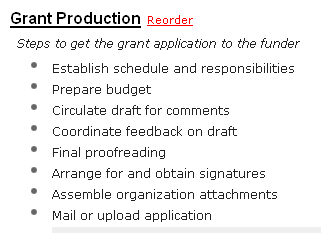
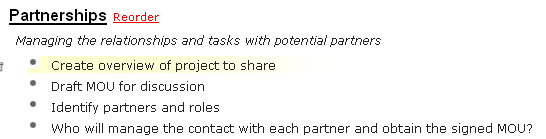
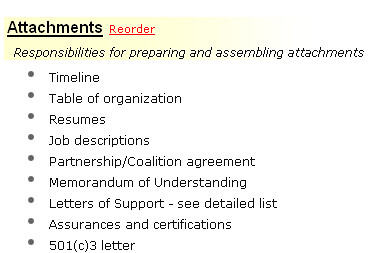
I've mentioned before that I use Basecamp as my collaboration site. I've set up templates of to-do lists there that I then tailor to each grant and client, adding who's responsible. They look like this (these are images, no time to retype):


So, if checklists work for surgeons, pilots, and astronauts, I guess they're good enough for me, too.

Do you have a checklist you use? Tell us about it and how you use it.

Reblog this post [with Zemanta]

Thursday, January 15, 2009

#70: Grant Writer, Don't Research

EFF says Cory is a superhero and they mean it;...Image via WikipediaI really like this tip from Cory Doctorow, co-editor at BoingBoing, and a prolific writer. It further refines something I do when I finally settle down to write.

Locus Online Features: Cory Doctorow: Writing in the Age of Distraction: "Don't research
Researching isn't writing and vice-versa. When you come to a factual matter that you could google in a matter of seconds, don't. Don't give in and look up the length of the Brooklyn Bridge, the population of Rhode Island, or the distance to the Sun. That way lies distraction — an endless click-trance that will turn your 20 minutes of composing into a half-day's idyll through the web. Instead, do what journalists do: type 'TK' where your fact should go, as in 'The Brooklyn bridge, all TK feet of it, sailed into the air like a kite.' 'TK' appears in very few English words (the one I get tripped up on is 'Atkins') so a quick search through your document for 'TK' will tell you whether you have any fact-checking to do afterwards. And your editor and copyeditor will recognize it if you miss it and bring it to your attention."
When I'm finally writing, all my research and data gathering behind me, I just write. FAST as I can. (No editing, either. Just write.) When I come to something I have to look up, even in my notes, I type a question mark or two and highlight.Then I keep writing.

The yellow highlighting makes the points that need attention later stand out, but the action of highlighting takes me away from the keyboard. I wonder if I can use TK and highlight all the TK's later with a "find and replace."

I'll try it out today. I just finished a big YouthBuild grant last night (I don't need to remind those of you working on it that today's the deadline!), so I'm cleaning up and playing today.

BTW, Corey's whole article is worth reading. I can't imagine writing without Word, though.
Reblog this post [with Zemanta]

Saturday, January 10, 2009

#69: Should Grant Writers Appeal to the Right Side of Their Brains?

This is an image taken from a typical PET acqu...Image via WikipediaRecently Scott Flood posted about appealing to both sides of the evaluator's brain.
Anyone who has ever prepared a grant application for a nonprofit or for-profit organization would probably tell you that it’s a left-brained process. After all, there is usually a lengthy list of elements and questions that must be addressed in a specified length and a particular order. Given that “order” is one of the left brain’s favorite words, it’s no surprise that the left-brain crowd is adept at gathering all the information and putting it in its proper place.

But the people who view developing grant requests as a wholly left-brained process are missing what separates very effective and memorable grant applications from the ordinary ones.

That something is the right side of the brain....

The key is recognizing that there are also two sides to the way people think, and addressing both of them....
I heartily agree. In fact, in sales they argue that we make our decisions based on emotions and then use the facts to justify them. You need to create an emotional commitment first.

I work very hard to appeal to both sides of the brain. It isn't easy within the given space constraints. Take the YouthBuild grant I'm working on today -- seems like they take more than 20 pages to ask the questions than the
20 page limit they give me for answers.

How to do it?
Well, the first place to focus on -- the need section. I try to paint a picture of the need that brings all those statistics alive.

How do you appeal to the right side of the evaluator's brain?


If you liked this post you may want to sign up for automatic updates. You can choose the RSS feed or an email subscription at the bottom of the sidebar.
Reblog this post [with Zemanta]

Tuesday, January 06, 2009

Limits on Exec Compensation in Grant Applications

337/365: The Big MoneyImage by DavidDMuir via FlickrNow, here's a clause in an RFP that I've never seen before. This is from an OJJDP Gang Prevention RFP that came out this past week. I guess if Wall Street had to give up their bonuses, nonprofit managers have to make sacrifices, too.

Limitation on Use of Award Funds for Employee Compensation; Waiver. No portion of any award of more than $250,000 made under this solicitation may be used to pay any portion of the total cash compensation (salary plus bonuses) of any employee of the award recipient whose total cash compensation exceeds 110 percent of the maximum annual salary payable to a member of the federal government’s Senior Executive Service (SES) at an agency with a Certified SES Performance Appraisal System for that year. (The salary table for SES employees is available at www.opm.gov.) This prohibition may be waived at the discretion of the Assistant Attorney General for the Office of Justice Programs. An applicant that wishes to request a waiver must include a detailed justification in the budget narrative of the application.


To save you time, here's the link to the Salary Table No. 2009-ES The maximum compensation for a Federal Sr. Executive Service with a "Certified SES Performance Appraisal System" is $177,000. So, if any of your executives are paid more than $194,700, don't charge any of that compensation to your proposal budget.

My clients are all wishing this was relevant to their compensation! Oh, well...

We'll probably see more of this. Do you think it will be applied to Federal contracts in the for-profit sector?


If you liked this post you may want to sign up for automatic updates. You can choose the RSS feed or an email subscription at the bottom of the sidebar.
Reblog this post [with Zemanta]

Thursday, January 01, 2009

Happy New Year to All


May 2009 bring better times --

- a new president

- a better economy

- a warm circle of friends and family

- new things to learn and share

and many things to celebrate


Thank you for all your kind words and support.


Ruth Wahtera
Posted by Picasa

Wednesday, December 17, 2008

# 68: The match: How should a grant writer value volunteers hours?

Volunteers fit new windows at The Sumac Centre...Image via Wikipedia

When a grant application requires a match, most organizations will find it "in-kind." And, often much of the in-kind comes from volunteer hours. After all, where would non-profits be without volunteer hours? Many programs just couldn't fly.

So, how much are volunteer hours worth?

Independent Sector makes a rate available each year that's accepted by the Feds— currently $19.51/hour. They also list the value of a volunteer hour by state -- in NY state, where I am, the 2006 value was $26.18.

In addition, if a professional volunteers their professional services you can value them at their standard billing rates. Make sure you have documentation from them about their rate.

Points of Light Institute now has a calculator that uses Department of Labor rates to assign acceptable values for different kinds of volunteer labor. Careful, though. The rate is for the work, not the person, so, using the example from the Independent Sector, a doctor volunteering to paint a fence is worth a painters rate, not an MD's.

My clients use these different rates without any problem for both the grant application match and for valuing the documented in-kind hours for reporting purposes.


If you liked this post you may want to sign up for automatic updates. You can choose the RSS feed or an email subscription at the bottom of the sidebar.
Reblog this post [with Zemanta]

Tuesday, December 16, 2008

Will funders take the GEO's advice?

day in the life: lunch moneyImage by emdot via FlickrPhilanthropy Journal reports that Grantmakers for Effective Organizations (GEO), a coalition of funders, has sent its membership of 1,700, representing 350 grant-making organizations, an open letter urging five actions that can help nonprofits make it through these tough times.

Those recommendations:
Funders urged to show leadership | Philanthropy Journal:

* Hold 2009 grant budgets steady at 2008 levels, a move that could mean paying out more than 5 percent of assets.

* Look for 'no-cost' ways to boost nonprofits, including releasing restrictions on current grants, and thus allowing nonprofits to react to the changing environment.

* Give grantees more flexibility to update, alter or replace programs by providing operating grants; consider providing cash-flow loans or access to credit.

* Continue making high-dollar, multi-year grants, investing in leadership support, and funding efforts to learn and evaluate.

* Engage with key stakeholders to better understand the challenges they face and how funders can help."


Hat tip to Mike Burns at Nonprofit Board Crisis blog, one of the blogs I keep in my RSS feedreader.
Reblog this post [with Zemanta]

Sunday, November 30, 2008

What Can Grant Writers Expect from the Obama Administration?

Barack Obama speaking in Houston, Texas on the...Image via WikipediaOne of my clients sent me a link to this article anticipating what the new administration may focus on. I pass it on to you.

eCivis: Improving Grants Performance: "Grants in the Obama Administration

With the election of Barack Obama, many in the grants world have been reviewing campaign materials, speeches, and debates to determine what is likely to happen in terms of grants. In general, funding can be expected to increase dramatically in many areas, including programs for low-income individuals and families, child education, and law enforcement. eCivis has reviewed many of the recent materials, and while there are no guarantees of what will actually happen versus what has been promised, there are some indications of what grant-seeking organizations are likely to see: read more here"


For most of us, the news is good -- more money for after school programs, head start programs, community development.... Of course, to quote an earlier presidential campaign, "It's the economy, stupid." So, we'll see.
Reblog this post [with Zemanta]

Monday, November 17, 2008

#67: A Checklist for Beginning a Grant Writing Assignment for a New Organization


Tara emailed me asking whether I have a form that I use when I go to see a new client. I don't. But, I jotted down a few things for her and then thought I'd share them with you, too.

When a new (to me) organization engages me to do a piece of work, here's how I get started.

Before my initial interview in person or on the phone:
  • Review the organization's 990 and website
  • Ask them to send me a packet of their PR materials, any boiler plate they have, and perhaps an earlier grant application they've submitted.
  • Do a Google search on them including news and blogs
  • Sometimes I'll review the research and best practices prior to the first meeting, sometimes later
Based on that, I usually go into the interview with a pretty good idea of the public face of the agency. Then, if the interview is for a specific grant, we discuss:
  • Project orientation - how we'll work together, who's on the team, who's the agency's lead, what tools we'll use, time table, etc.
  • What makes them want to apply for this grant? What are they currently doing makes them feel they have a good chance at receiving the funding?
  • Review the grant requirements - assume they haven't read the details
  • Walk through each section of the application and appendices discussing content, identifying what information is outstanding, determining who will get it, by when.
If they are asking for help to identify new funding opportunities we discuss
  • Current operations
  • Strategic direction
  • Previous and current funders
  • Applications submitted but not funded
  • How we'll work together
Does this sound like what you do? Do you have additions?

Thursday, October 30, 2008

#66: More Grants.Gov Resources for Grant Writers


I've had this grants.gov update in my draft folder for awhile now. Sorry I haven't published it sooner. This technical grants.gov stuff is pretty boring, but there's nothing worse than trying to find information about grants.gov in a hurry, so I push myself to read whatever they send.

By the way, if you haven't used the new Grants.gov Adobe system Federal agencies are now using, allow plenty of time ( an extra day or two) for the upload. Everything went fine as I prepared to upload the last Federal grant I did until I clicked on submit. The system went off into La-la land.

The Help Desk had to walk me through some convoluted tricks to get my application loaded. I wouldn't want to 1) try to reach them and 2) follow the directions while the clock was ticking away.

So, here are some new (well, they were new when I put them into my draft folder mid-September) Grants.gov resources.

New Troubleshooting Tips Webpage Added to Grants.gov
Grants.gov has added a troubleshooting tips page as an additional resource for applicants. The new resource concentrates on common troubleshooting issues such as verifying your Authorized Organization Representative (AOR) status, login for E-Business Point of Contact (E-Biz POC) and accessing search results. These troubleshooting tips can help you quickly resolve your technical issues. To visit the troubleshooting tips page

Subscribe to the Grants.gov Blog
Check here daily for system status, opportunity updates and new blog entries.Grants.gov Blog.
And there's a newsletter, too
The “Succeed” E-Newsletter is a guide to the latest updates, handy tips and useful articles on how to best use Grants.gov. Subscribe to the 'Succeed' E-Newsletter

I like to submit my Federal grants at night when everything is quieter. If you're inclined to do that, too, be aware that the Help Desk closes at 9 pm. When I needed help it was 8:20 pm. The person who helped me was great -- knowledgeable and pleasant. We worked steadily through the secret process (you'll never find it documented anywhere) and finished right at 9 pm.

Wednesday, October 15, 2008

Blog Action Day: Give your thanks and a check

Thank you everyone!Image by J.Starr via FlickrThis year Blog Action Day is focused on Poverty (with a capital P). As a grant writer, almost every proposal I write addresses poverty in some way. I hear the stories of poverty from the people on the front lines.

I think Blog Action Day is a fitting time to say thank you for the work my clients, and your clients, do every day to fight poverty. Sometimes it's through job training and work readiness; sometimes through food pantries. Often it's through a combination of community organizing and skill building. Helping people develop a vision for what's possible and find the tools to make it happen.

Often, the people who are fighting poverty -- agency staff -- are on the edge of poverty themselves -- just one or two paychecks away from personal financial disaster. In large part that's because our agencies squeeze so much into the proposals we write. They want to do so much with so little. Unfortunately, it also reflects how we, as a society, value the work that they do.

So, today the blogosphere is focused on poverty. Bloggers are filling the net with ideas about what you can do to fight poverty today. Write a check, feed people, educate yourself -- you can follow what's happening here. But, I'd like you to do something else, as well.

Say thank you to the people you know who do the work of fighting poverty every day. Acknowledge them. Appreciate the personal cost to them for choosing this work over other, more lucrative careers.

Oh yes, write a check for their agency, too.

If you liked this post you may want to sign up for automatic updates. You can choose the RSS feed or an email subscription at the bottom of the sidebar.


Reblog this post [with Zemanta]

Wednesday, October 01, 2008

Unraveling the Mysteries of Grant RFPs

The WriterImage via WikipediaJake Seliger has a guest post on his blog -- really a rant -- about how funders put RFPs together by committee. I thought I'd rant a bit right along side him.

Today I'm finishing up a proposal in response to a government agency-issued RFP and we still don't know whether we should be submitting a one year or two year budget. The Q&A's were posted the Thursday before the Monday-due-date -- 15 days later than their scheduled date for posting answers. They extended the deadline by four days and gave ambiguous answers to the questions.

Two of us combed this RFP to pull out what the agency expects and came up with different lists. The RFP has a section called "Requirements," another called "Expectations," another called"Instructions," and yet another called "How to..." Each adds a bit more or defines things a bit differently.

Jake says, and I couldn't agree more,
This death-by-committee effect isn’t unique to grant writing, but the combination of fear, pompousness, uncertainty, certitude and the like seems to lead to the production of especially unpalatable RFPs, and the nature of bureaucracies make potential reforms difficult to implement. In addition, RFP writers seldom have to respond to the RFPs they produce, or any other RFPs for that matter, and thus don’t understand the kinds of problems we describe.
We do the best we can. When in doubt, I choose what will make my proposal clear and readable. Read Jake's post here.
Inside the Sausage Factory and how the RFP Process leads to Confused Grant Writers: "Inside the Sausage Factory and how the RFP Process leads to Confused Grant Writers"
Reblog this post [with Zemanta]

Friday, September 19, 2008

Waukee builds a grant writing resource

Iowa state welcome signImage via WikipediaThe most difficult calls I get are from very small community groups -- very dedicated people -- looking for help with great ideas they need grants to implement. I often meet with them, give lots of free advice, and wish them well. Unfortunately, this is how I make my living -- I can't afford to give away my time and they can't afford to pay me.

A community in Iowa has come up with an interesting community service that could help -- a non-profit Grant Writers Group.
The grant-writing project got a jump-start in April when it received a $2,000 grant of its own from Community State Bank. Fourteen Waukee residents will use the money to attend two separate grant-writing classes this fall. After the classes have concluded, the group will meet regularly to create a list of projects that need money. The first grants could be finished by the end of the year. [Story link]

Update: this story has been taken off-line, but the group has a webpage here.
My impression from the brief article is that this is a community-focused group, rather than an organization-focused one. They will find the projects that need help, rather than the organizations. Great approach! (And potential competition.)
Update March 2011: the website is now gone, too. Too bad. It's a good idea. Maybe they got a few projects funded, though.

If you liked this post you may want to sign up for automatic updates. You can choose the RSS feed or an email subscription at the bottom of the sidebar.
Enhanced by Zemanta

#65: Grant Writers Can't Fake Collaboration.

Katie Krueger has a great post about her stint as a grant reviewer at the Wisconsin Department of Instruction. They used an interesting process. She describes reviewing grants as the best professional development a grant writer can undertake. I can believe it!

Katie offers some clear advice about how to make life easier for the reviewer. This one caught my attention. I've not heard a reviewer comment on this before.

Secrets From a Grant Reviewer on How to Win Grants: "Include your partners in the planning of the grant application.This was a surprise to me, but it was very clear whether or not applicants had worked with the partners they listed in designing the program and writing the grant. If not, the descriptions of partners’ roles were vague.If they had included them, their specific role with a list of duties and responsibilities were in the application.This cannot be faked. Planning with partners beforehand will set you apart from other applicants."


Thanks for the insight, Katie.

Sunday, September 14, 2008

#64: Foundation Center - Cooperating Collections

An index card in a card catalogImage via Wikipedia Did you know that any grant writer can have access to many of the Foundation Center's resources through their cooperating collections?
Foundation Center - Cooperating Collections: "Participants in the Foundation Center's Cooperating Collections network are libraries or nonprofit information centers that provide fundraising information and other funding-related technical assistance in their communities. Cooperating Collections agree to provide free public access to a basic collection of Foundation Center publications during a regular schedule of hours, offering free funding research guidance to all visitors. Many also provide a variety of services for local nonprofit organizations, using staff or volunteers to prepare special materials, organize workshops, or conduct orientations."
Check it out. There may be a location near you where you can search the Foundation Center's database for the cost of your free library card. Oh, don't let the image mislead you. The database is electronic.
If you liked this post you may want to sign up for automatic updates. You can choose the RSS feed or an email subscription at the bottom of the sidebar.
Reblog this post [with Zemanta]

Friday, August 29, 2008

#63: Sustainability -- Another Word for Long Term Survival

The Front of the SAMHSA building at 1 Choke Ch...Image via Wikipedia SAMHSA has just published a useful guide for grassroots nonprofits that as grant writers we should add to our resource file. A comprehensive RFP almost always has a question about sustainability and I often find that the team wants to answer "We'll look for another grant." -- Clearly, not what the funder is hoping to hear.

Although as grant writers we seldom carry responsibility for implementation, we should be prompting the team to think long and hard about implementation and sustainability. This toolkit addresses the full range of issues that impact survival including marketing, financial management and fundraising. It contains lots of links to on-line resources. And, of course, you can't beat the price. it's free!

Sustaining Grassroots Community-Based Programs: A Tool Kit for Community-and Faith-Based Service Providers
Reblog this post [with Zemanta]

Thursday, August 14, 2008

#62: TIPS & RESOURCES FROM GRANTORS

Here's another grant resource from Grants.gov. They've collected links to all the grant pages for many of the government agent ...your tax dollars at work! I must say, it's pretty nice to have all these links in one place.

TIPS & RESOURCES FROM GRANTORS: "TIPS & RESOURCES FROM GRANTORS
... a listing of the 26 Federal Agencies and their resources.
Simply find the agency you are interested in and click on the link to be directed to their resources."

If you liked this post you may want to sign up for automatic updates. You can choose the RSS feed or an email subscription at the bottom of the sidebar.

#61: Read the 990 before you write your grant


Here's a nifty guide for grant writers to help you understand the 990 form. I usually read the 990 for any potential client or funder. It gives me insight into the client. And, because it lists who a foundation has funded and how much they gave, it will help you choose the right places to apply and reasonable amounts to request.

How to Read the IRS Form 990 & Find Out What it Means: "The Form 990, entitled “Return of Organization Exempt From Income Tax,” is a report that must be filed each year with the Internal Revenue Service (IRS) by organizations exempt from Federal income taxes under section 501 of the Internal Revenue Code, and whose annual receipts are 'normally' more than $25,000 a year. It is an information return and not an income tax return since the organizations that file it do not pay income taxes (except, as explained below, in certain cases an organization may have to pay an “unrelated business income tax”)."
The guide is from the NonProfit Coordinating Committee of NYC -- a great resource for non-profits.

If you liked this post you may want to sign up for automatic updates. You can choose the RSS feed or an email subscription at the bottom of the sidebar.

Wednesday, August 13, 2008

#60: Determining Your Fees for Grant Writing


Because my post yesterday was prompted by a July news article about a grant writer being investigated for fraud. I decided to see whether I could find an update. What I found was quite amazing.

Jean Cross was to collect a fee of $5.175M for writing that grant application!


Now, I like money as much as the next guy, and I certainly believe that my services are worth more than I can charge my non-profit clients. Cross' contract entitled her to 15% of the grant.

But, this is public money, earmarked for after school youth development programs.

Percentage payments from public monies has long been considered unethical. Fifteen percent to the grant writer? Come on!

Lawyer: 'No criminal activity' | MyDesert.com | The Desert Sun: "Writer to get 15 percent

According to a Feb. 27, 2007, contract between Cross Resources and the task force, Cross would receive 15 percent of the grant - $5.175 million over five years - in return for her services in preparing the application and implementing the programs.

The driving force behind returning the grant, Reiss said, was concern over Cross' compensation. When Wilson and Davis became aware of Cross' 15 percent fee, the Desert Sands officials 'bullied' the task force into returning the grant with the intention of reapplying to the state without Cross' services, Reiss said."
So, my additional questions are:
  • What public or non-profit official authorized a contract with a grantwriter that included a fee of 15%?
  • What funding agency approved a grant application that included a budget item paying a grant writer 15% for writing the application? Or was that money included in the budget with some other (? fraudulent) description?
Even if she was slated to play a significant role in "implementing the program" Cross would have been wise to separate the fee for writing the grant from the implementation fees.

Whenever I can, I charge my clients a flat fee. When the amount of work is unclear or open-ended, I charge an hourly rate. If you work free-lance, how do you determine your fees?
If you liked this post you may want to sign up for automatic updates. You can choose the RSS feed or an email subscription at the bottom of the sidebar.

Tuesday, August 12, 2008

#59: Who and How are Your Grant Applications Authorized?

City of San Luis ObispoSan Luis Obispo image via WikipediaGrant writer Jean Cross is being investigated for fraud. There's not enough information in this article to determine whether this grant writer's procedures were sloppy or actually fraudulent, but it does make one pause. Two questions come to mind. (See below.)

San Luis Obispo County’s website | 07/20/2008 | Local woman target of D. A. inquiry: "The Riverside County group Cross was working for included numerous Riverside County schools as well as the area YMCA. She wrote a federal grant application on their behalf that was for programs for school-age children overseen by the Indio Youth Task Force.

According to a story published July 13 in the Palm Springs Desert Sun, Cross allegedly used 33 forged signatures on the grant application. The Task Force decided to send back the grant money because of concerns about the content of the grant application after it was awarded.

Some Task Force members contend that Cross was not authorized to use their “wet signatures,” transferable signatures sometimes used for official documents, without their knowing the contents of the application. Cross’ attorney rejects that. “Forgery is a crime that involves fraudulent intent to do something,” Reiss said. “She had no fraudulent intent to do something. She had a positive intent to do something for a lot of kids.”

“There’s no criminal activity, and that’s an accurate statement,” Reiss said. “We have been totally transparent with the Riverside District Attorney’s Office and its chief investigating officer.”

My questions:
  • When you write a grant for a coalition, do you see all the signatures on the MOU or do you trust that the lead agency has them on-file?
  • Does the person authorizing submission of your application review it or delegate the review? If they delegate, has it ever backfired on you?
Reblog this post

Monday, August 11, 2008

#58: A Service Learning Resource for Grant Writers

To what extent do participants in joint activi...Image via WikipediaYouth Service America has just published a pdf handbook Effective Practices for Engaging At-risk Youth in Service While it's specifically addresses service-learning, I think the principles are on-target for any youth program. I'll keep them in mind when I write any youth development grant.
  • Principle 1: Design an outreach strategy that includes at-risk youth.
  • Principle 2: Create a “home base” with adults who themselves have once been identified as at-risk. Many of them have “been there and done that.”
  • Principle 3: Convey a philosophy of change and both short- and long-term goals for the youth participants and the community.
  • Principle 4: Identify issues that connect to these youths’ experiences and explore the causes of each of the risk factors
  • Principle 5: Create youth and adult teams since each can learn from and contribute to the growth of others.
  • Principle 6. Build youth and adult capacity since each can serve as leaders.
  • Principle 7: Continue to provide these youth with supports to manage daily life stressors, such as family dynamics, relationships and school.
  • Principle 8: Sustain access and influence by continuing to develop links to other community organizations that can expand opportunities for meaningful participation of all youth.
The handbook is a good compendium of information and a quick read. I recommend it.
If you liked this post you may want to sign up for automatic updates. You can choose the RSS feed or an email subscription at the bottom of the sidebar.
Zemanta Pixie

Sunday, July 20, 2008

# 57: Submit an unsolicited grant proposal


Have you ever submitted an unsolicited grant proposal to the feds and had success? It's one of the strategies recommended by Cynthia M. Adams, CEO at GrantStation, in her series Understanding the Philanthropic Landscape.

GrantStation.com - GrantSeeker's Toolkit: "If you can't find a funder for your project, yet you strongly believe it should be funded, consider submitting it to a federal agency as an unsolicited proposal. This is the most difficult means of obtaining federal funds, but one that should be pursued if you think your project fits the goals and mission of a particular agency."
I haven't tried it, but it seems worthwhile if you can track down the right person to send it to. I think you'd have to balance your investment in preparing an unsolicited package with the odds that the agency will be interested. If you've been in conversation with the agency already, or have received funding from them for a related project, this might well be worthwhile.

So, does it work? Tell us your story. Please!

Sunday, June 08, 2008

#56: Evaluation Tools for Your Grant Application


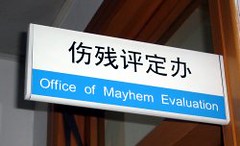
Clients often have a difficult time determining an easy, low cost, and meaningful way to evaluate the impact of their program. In fact, the evaluation process does, on occasion, devolve into mayhem! Here's a United Way website that youth development programs may find useful.

Toolfind - Youth Outcomes Measurement Tools Directory | United Way of Massachusetts Bay and Merrimack Valley: "Toolfind is a free directory designed to help professionals in youth-serving programs find measurement tools for up to 11 youth outcome areas. Your time is valuable, so we have identified 46 tools to help you get started. All tools address one or more of the outcome areas, are tested, low-cost and have few restrictions. Tools included in this database address elementary, middle and/or high school students and youth, parent, staff and teacher respondents."

Photo cropped from a photo by Xiaming

Wednesday, June 04, 2008

# 55: SMART Maps for Grant Writers

OJJDP is the grant writer's new best friend when it comes to finding and mapping data about those socio-economic factors that place kids at-risk. The site builders are gathering information from a variety of sources and making it available down to the census tract level in maps, charts, text.
About SMART
The Socioeconomic Mapping and Resource Topography (SMART) System

"The SMART System for Kids"
What is it? The SMART System is a Geographic Information System (GIS)-based issues management system, developed to support the early identification of emerging local issues and provide resources to assist decision makers with implementing both rapid response and long-term plans.

The third phase of SMART has been completed. At this time, we have archival data mapped at the national, state, county, and census tract, and place/street levels. This data is coming from multiple sources, including: the United States Census Bureau, OJJDP’s Statistical Briefing Book, the Helping America’s Youth website, and the Office of Justice Programs’ Grants Management System.

This system will allow the users to locate resources and incidents of crime and delinquency and other social indicators, visualize the data, and perform complex location-based analysis that should lead to better decision making.

Thursday, May 22, 2008

#54: How to position your grant proposal financials


Yesterday I had lunch with a fellow free-lance grant writer, Jim Kopp. I don't often have the opportunity to talk face-to-face with other grant writers, so I enjoyed the camaraderie.

At one point in our conversation, Jim commented that he often has to explain to clients the importance of presenting a project proposal within the context of the organization's overall financial picture. Some clients resist sharing their financials with funders. They forget that information is available to the world on the organization's 990 form.

So, here's a tip from Jim. The funder can look at the agency's finances anyway. Your job, as a grant writer, is to make it easy for them to see how this project fits into the big picture.

This is so important. In fact, when the Foundation Center asked the question, "How do you usually read a grant request?" here's what some of the respondents had to say:

"I look at the budget. Over the years I've learned that narrative can be enriching, but the numbers are stark and straightforward. I want to see that the money is doing the job described in the proposal." Joel Orosz W.K. Kellogg Foundation

"I skip around the document in the following way: first the budget, to see if the request is appropriate and to see the agency's financials; then the project section, to see what they want to accomplish; then the board list." Lynn Pattillo The Pittulloch Foundation, Inc.

"I often look at the budget and then read the proposal backwards." Michael Gilligan The Henry Luce Foundation, Inc.

If you're new to preparing grant budgets, the Foundation Center offers this [free] basic tutorial.

Tutorials - Proposal Proposal Budgeting Basics: "This online course is designed to help with the basics of developing a project budget, and it is geared for those who have general knowledge of proposal development.

Wednesday, May 14, 2008

#53: Say Thank You for Your Grant


Here's a tip from an excellent article. If you're a grant writer you should read the whole article, The Secret Life of Foundation Officers as told by Lee Draper, but I selected this particular tip to share. Since I'm an independent consultant, I'm not the one who gets the grant and wouldn't be the one to write the thank you. However, I'm embarrassed to say that I never had this on my list of tips to share with clients.

Thanks, Lee, for this and your other tips.

NCFY : : Publications : :The Exchange: "One other thing is, when you’re successful, write a thank-you note within 2 or 3 days. The number of nonprofits that do not thank their funders is very high. And what does that say to the donor? That says you are ungrateful. When you send a thank-you note, it makes the funder feel appreciated. They feel you care. And they will be receptive the next time you come with a new proposal. I cannot tell you how frequently I hear my colleagues who are grant makers say, “A third to half of our grantees never send a thank-you note. And they think that we’re going to fund them next year. Ha, ha, ha.” So that gets back to the fact that those are people behind the desk. And when they have helped you, it’s important to remember to thank them."
And, for my own self-interest, send your grant writer a thank you, too. It's one way of ensuring she knows you received the award. It amazes me how often people forget to let us know. And, of course, we like to be appreciated, too.

If you liked this post you may want to sign up for automatic updates. You can choose the RSS feed or an email subscription at the bottom of the sidebar.

Thursday, April 24, 2008

#52: Thirteen Proofreading Tips for Grant Writers


Thanks to Lynn Gaertner-Johnston for these tips published in her March e- newsletter. Visit her site and sign up for her newsletter.

13 Secrets of Professional Proofreaders
Proofreaders would not stay employed if they missed the errors that pass many of us by.

To be sure your message sustains your readers' confidence,
apply these "secrets" of professional proofreaders:

1. Professional proofreaders don't read straight through from beginning to end. They read each element of content separately. For example, they read the headings, check the formatting, review the headers and footers, and read the text all in separate steps.

Proof like a pro: Review each element of content separately. Even in email, review your subject line, check your attachment, test your hyperlinks, and read your message in separate, systematic steps.

2. Proofreaders check every aspect of a document: text, fonts, font sizes, page numbers, lists, titles, footnotes, illustrations, tables of contents, captions, etc. In recurring communications such as newsletters, they check everything that changes: volume numbers, dates, titles, and so on.

Proof like a pro: Remember to check everything--even boilerplate content, which may need to be updated to suit the situation. Read every slide in PowerPoint.

3. Proofreaders double-check the spelling and capitalization of all proper names.

Proof like a pro: Be sure to spell your reader's name and company name correctly. Misspelling names is one of the most common errors in email. (I will attest to that fact, as someone who is frequently called Lyn, Lynne, and Lin and whose surname is often mangled.)

4. Proofreaders confirm specific details such as people's titles, email addresses, phone numbers, and locations.

Proof like a pro: Use the Web to check addresses and titles, and test phone numbers by calling them. For speeches and presentations, do Internet searches to verify quotations and historical references.

5. For online documents, proofreaders test every link to ensure that it is live and named or described accurately.

Proof like a pro: For email, send a test message to yourself to check links and formatting.

6. Proofreaders check numbers in a separate step. They compare final numbers with original source documents such as calendars, purchase orders, price lists, price quotes, and invoices to ensure a match.

Proof like a pro: Don't assume numbers are correct. Confirm them using other sources. Make sure all numbers are current.

7. Proofreaders work in pairs when documents are highly complex or technical. One person reads aloud while the other proofreads silently.

Proof like a pro: Work in pairs when a report or proposal is crucial to your success.

8. Proofreaders read from a printed page rather than a screen. They read line by line, often using a straight edge such as a ruler or an opaque sheet of paper to help them focus on each line.

Proof like a pro: Avoid proofing solely on the screen. Print important documents and read them line by line.

9. Proofreaders read aloud when they are having trouble concentrating.

Proof like a pro: Take the time to read important messages aloud. Run your finger under the words to guard against reading words that aren't there.

10. Professional proofreaders read other people's work, reviewing it with a fresh set of eyes.

Proof like a pro: If you can't swap documents for a fresh look, at least put aside a document for a few hours or overnight. That way, you can give it a fresh reading.

11. In the absence of copyeditors and fact checkers, proofreaders take responsibility for factual accuracy. They either confirm a fact or write "Cannot confirm."

Proof like a pro: Verify dates, places, times, prices, and any other information that is available to you. If you can't verify a fact or figure, find someone who can. In a proposal, a mistyped date or misplaced decimal point can make a million dollar difference.

12. Proofreaders make and follow a list of style choices. For example, if SHUTTLE is rendered in all capital letters on page 1, proofreaders make sure the word is in all caps on pages 12 and 20.

Proof (write) like a pro: Use your software to automatically type, correct, and format words. For example, don't repeatedly type long names such as Weyerhaeuser and Fred Hutchinson Cancer Research Center. Use AutoCorrect, AutoText, and AutoFormat to render words consistently and easily.

13. Professional proofreaders keep their skills and knowledge fresh. They buy the latest style manuals and keep up with trends in language.

Proof like a pro: Include a new style manual or dictionary in your annual budget. Subscribe to online directories. If you are aware of a skill gap, fill it. If you get stuck on confusing words, get "60 Quick Word Fixes," which explains 60 challenging word pairs and provides easy memory aids.

Apply one or more of these proofreading techniques the next time you proofread an email or other communication. Then enjoy the relief and satisfaction of catching your own errors.


If you liked this post you may want to sign up for automatic updates. You can choose the RSS feed or an email subscription at the bottom of the sidebar.

Sunday, April 13, 2008

#51: Use Readability Statistics to Improve Your Grant Application


I find it hard to believe that I've offered fifty grant writing tips and I haven't included readability statistics yet. If you use WORD you'll find this an invaluable feature.

These are the statistics for a draft of a grant I was working on last week. I check on the statistics periodically, and always before I start serious editing.

Here's what these statistics tell me to look for when I'm editing:

Sentences per Paragraph 2.9 -- that's low. Low is good. It means lots of white space; separation of ideas. But, it's probably skewed by my frequent use of bullets.

Words per Sentence 17.6. TOO LONG! Well, now I know that as I edit I should look for sentences that include more than one thought.

Passive Sentences: 6% -- Good girl, Ruth! I've work hard to build the habit of writing in the active tense. I've written about that elsewhere.

Flesch Reading Ease Score: Rates text on a 100-point scale; the higher the score, the easier it is to understand the document. For most standard documents, the 'experts' aim for a score of approximately 60 to 70. Hmmm, mines only 36.1.

The formula for the Flesch Reading Ease score evaluates average sentence length (the number of words divided by the number of sentences) and average number of syllables per word (the number of syllables divided by the number of words). So, if I can reduce my sentence length by eliminating unnecessary wordiness and limiting sentences to one thought, I can probably get this score up.

Flesch - Kincaid Grade Level
-- Rates text on a U.S. school grade level. For example, a score of 8.0 means that an eighth grader can understand the document. For most documents, aim for a score of approximately 7.0 to 8.0. 12.6, my score, not good. Eighth grade can be tough a tough target for some grant applications, but I'll do what I can. This grant dealt with the court system and had significant court-related language.


How to Turn Readability Statistics on: Tools>>Options>> Spelling & Grammar>> then check 'Show readability statistics.' Once you've turned this option on, Readability Statistics display every time the spell-checker completes its review of your document.

(Note: In this same screen, you can also click settings to adjust the grammar checker to reflect your preferences regarding style and punctuation issues. OOPS! Does that count as resource #52?)


If you liked this post you may want to sign up for automatic updates. You can choose the RSS feed or an email subscription at the bottom of the sidebar.